


Brak produktów w koszyku.
VR charging case or cabinet: how to compare quotations
VR charging case or cabinet: how to compare quotations
Two quotations may both promise storage for a full classroom set while allowing for very different head straps and batteries. Start with the equipment the instructor actually puts away after a session. Then compare capacity, charging and price on the same basis.
Define the equipment that needs to fit
A quotation request should name the headset, head strap and how the controllers will be stored. Include any additional battery and covers that stay attached between sessions. The case or cabinet needs to hold that complete assembly, rather than the bare headset shown in a product photograph.
Measure it in its storage position, with the charging connector plugged in. Record width, depth and height. Also note whether putting it away requires folding the strap, removing the battery or placing controllers in a separate container. Each of those tasks will return when the next group finishes.
Send the supplier a photograph of the arrangement and its measurements. Ask for confirmation of that specific configuration, rather than just “Quest” or “PICO”. The comparison below shows how to read a quotation. It is based on documentation, not a fit test performed by ZenithXR.
Two actual models and their usable dimensions
We selected a case and a lockable charging trolley from Zioxi's current catalogue. Both have manufacturer pages with an enquiry option. That establishes that they are offered, rather than confirming stock or a delivery date to Poland.
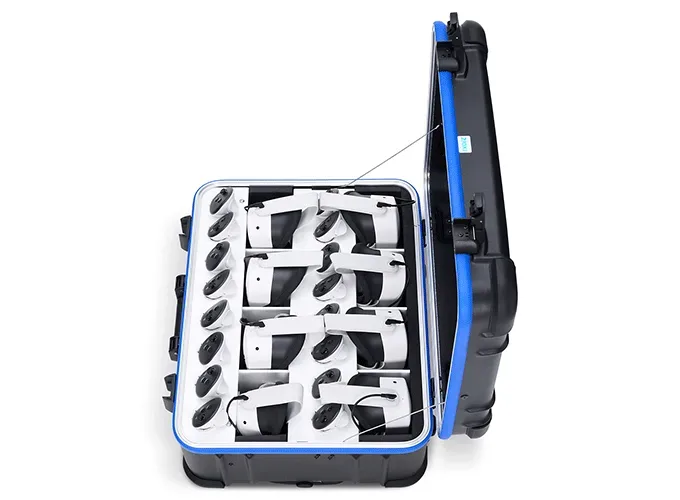
Zioxi TRANUC-XR-08-UK# charging case:
- Capacity: 8 headsets with flexible straps or 4 with rigid straps.
- Compartment: 200 mm wide, 305 mm deep and 125 mm high.
- Charging: 8 USB-C ports, up to 20 W per port; the # version includes cables.
- Transport: telescopic handle and wheels. Charging with the lid closed is allowed by the manufacturer.
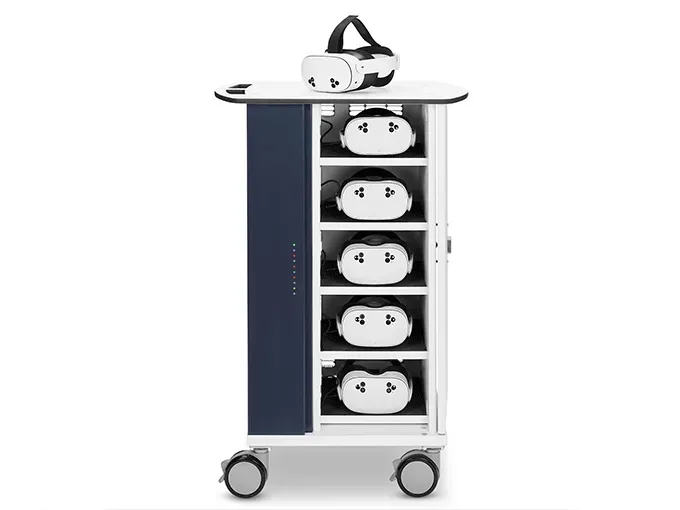
Zioxi CHRGTUC-XR-10-K-UK charging trolley:
- Capacity: 10 headsets with flexible straps or 5 with rigid straps.
- Shelf aperture: 260 mm wide, 360 mm deep and 137 mm high.
- Charging: USB-C PD 3.0, up to 20 W per port; this version excludes USB cables.
- Access: key lock, lockable wheels and a power compartment accessible from the front.
For a proposed set of five rigid-strap headsets, the first option has insufficient stated capacity; the second lists five places. That is a comparison of documented capacities, not confirmation that a particular strap fits. Eight charging ports do not automatically mean eight storage spaces for every assembly.
Check the space around the equipment too
Compartment dimensions describe the space inside. A room plan also needs external dimensions and clearance for opening the doors or lid. Ask the supplier to add these to a simple layout drawing, with units and the opening direction marked.
Walk the route from storage to the teaching area with that drawing. Include doors, thresholds, lifts and the point where participants will collect their equipment. If the kit will travel by car between sites, ask how it should be secured for transport and what it weighs when fully loaded. Wheels alone do not answer those questions.
For a case, inspect the position of the cables when the lid closes. For a cabinet, check whether one headset can be removed without moving its neighbours. Request a demonstration with the head strap and battery fitted if that is how your equipment will be used.
Separate charging power from readiness for a session
Power per port helps compare charging systems, but it does not by itself establish headset charging time. Ask whether the stated power applies to every port with the full set connected, or only to a particular loading arrangement. Include the devices' required charging profiles and the proposed connection for any additional batteries.
Next, define a trial around your timetable: the same headsets, their initial battery levels recorded, all devices connected together and a second reading after the actual break between groups. One acceptance criterion could be that every station reaches the battery level required for the next planned exercise. That level first needs to be established for the application you use.
Do not enter a promised empty-to-full charging time unless the supplier has documented it for this configuration. The trial record should identify individual headsets that did not start charging, instead of reporting only an average battery level for the whole set.
Inspect cables, ventilation and day-to-day access
Separate the enclosure, charging system, cables and any docking stations in the quotation. Record quantities and connector types. An offer without cables can appear cheaper until the missing set has to be purchased.
Ask the supplier to show how a damaged cable is replaced. Can the instructor reach it? Does replacement require a key, tools or a service visit? Where is a suitable spare available? Knowing this makes it possible to keep a replacement ready instead of losing access to a station over one damaged connector.
Instructions for charging with doors or a lid closed must come from the selected product's documentation. Permission for the case described above does not extend to any sealed storage box. Mark ventilation openings and required clearances on the layout. Store cleaning liquids and wet accessories according to their own instructions, away from the space used to charge the equipment.
Use the same request for every quotation
Ask each supplier to answer these points in the same order:
- Exact version: product code, included equipment, lock type, mains lead and plug suitable for the installation site.
- Your equipment: headset, strap, battery and controller models, with confirmation of their storage arrangement.
- Space: usable and external dimensions, opening clearance and the available transport route.
- Charging: power with all devices connected, necessary cables and a proposed trial between sessions.
- Maintenance: ventilation, cable access, replacement parts, warranty terms and delivery date.
The price can then be compared against the same equipment and daily routine. If you are still choosing the headsets, start with our guide to classroom VR kits. When requesting a VR classroom quotation, include your completed checklist and a photograph of a headset with its accessories fitted. That gives the supplier a practical basis for pricing storage, cables and charging for the kit you will actually use.

Author
Dariusz Walczak
Dariusz Walczak is responsible for marketing at Zenith XR. He manages the brand's communications and blog content.
Need specific advice?
Choose the right XR equipment for your needs
Tell us how you plan to use XR headsets. We will help you choose the right equipment for home, school or business.



Add comment