


No products in the cart.
VR headsets for children: minimum age, safety and which model to choose
VR headsets for children: what age are they suitable from, are they safe and which should you choose?
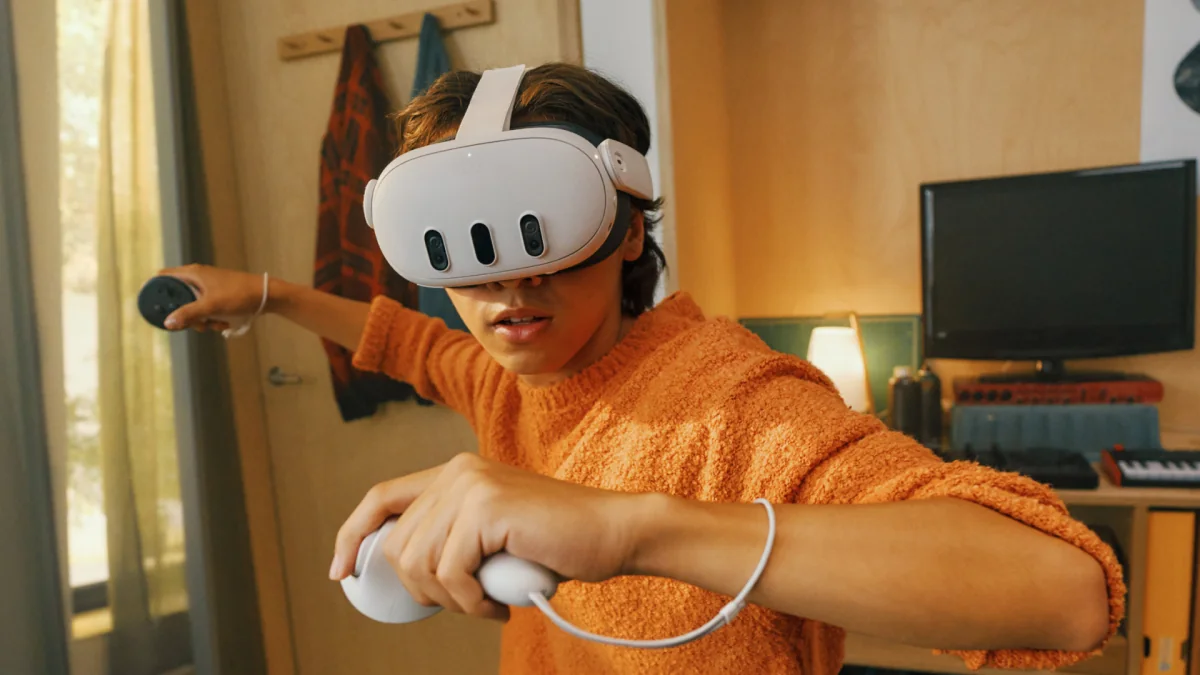
The question “what age” comes up more often than “which ones to buy,” and rightly so: manufacturers set age limits, and children’s heads and eyes differ from those of adults. Below, we’ve compiled information based on manufacturers’ guidelines, how VR is used in schools, and our own experience working with children ages 9–14. Without scaremongering or promising that VR is “completely safe”: it’s safe as long as you follow a few rules.
Minimum age: what manufacturers say
- Meta (Quest 3, Quest 3S): For children ages 10–12, parent-managed accounts are provided; full accounts are available starting at age 13. Parents approve apps, set time limits, and can see what their child is doing.
- Inni producenci (PICO, Sony, HTC) specify their own minimum age requirements in the user manuals and terms of service; this is usually 12–13 years old. Check the manual for the specific model before purchasing.
- In schools VR is most commonly used starting in 4th grade (age 10), in 10–15-minute sessions. Younger children are given short demonstrations with adult supervision, rather than being allowed to play on their own.
The age limit stems from two factors: the fit of the equipment (eye spacing, weight on the head) and the content (adult game stores, contact with strangers in online games). Both can be controlled, but this must be done consciously.
Does VR harm your eyesight?
There are no studies showing that short, moderate VR sessions cause permanent vision damage. However, there are three things that actually happen and are worth knowing:
- Eye strain after a long session, just like when using a phone or tablet held close to your eyes. Tip: 15–20 minutes, then take a break and look into the distance.
- Choroba symulatorowa (Nausea, dizziness) during fast-paced games when the image moves but your body doesn’t. Children are particularly susceptible to this. Tip: Start with apps where you stay in one place (exploring, drawing, sports without “riding”), and choose teleportation mode instead of smooth movement.
- Incompatible interpupillary distance (IPD). The headset is adjustable, but the lower limit is around 58 mm. Younger children often have a smaller interpupillary distance, which results in a blurry image and faster fatigue. That’s why manufacturers don’t recommend VR for the youngest children.
If your child wears glasses, check whether they fit under the headset (the Quest 3 and 3S have space and clearance for this), or consider prescription lenses that clip into the headset.
Rules That Really Work
- A parent’s account, not the child’s. Set up a supervised account, approve every app, and disable voice chat with strangers.
- Czas: 15–20 minutes per session, a maximum of 2–3 sessions per day, always with a break.
- Miejsce: 2×2 meters of clear floor space, with no table or glass doors within arm’s reach. The safety boundary in the goggles (virtual grid) must be enabled.
- Content: games and apps appropriate for the child’s age. To start with: exploring the world, anatomy, space, 3D drawing, rhythm games, and sports games.
- Adult supervision during the first few sessions. The child wearing the headset cannot see the room.
- Hygiene: Replaceable face pad; wipe the lenses with a dry microfiber cloth (not wet, not in direct sunlight).
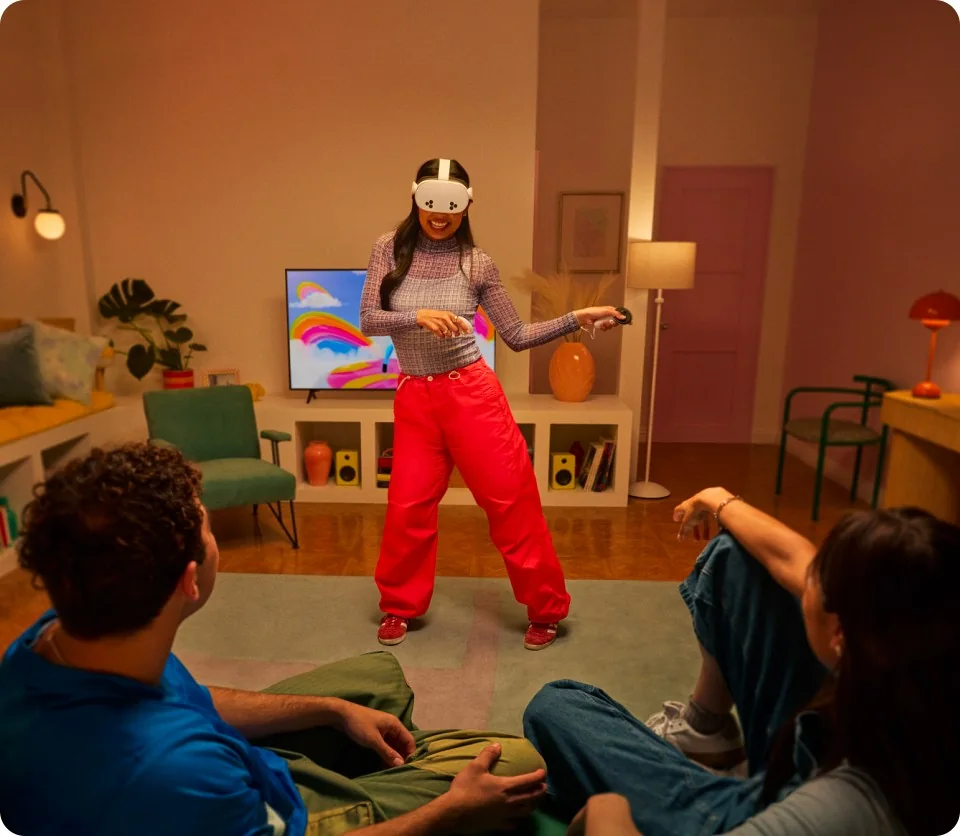
Which VR headset for a child: a comparison
For home use, choose a VR headset samodzielne, without a computer: simpler to use and with no cable for a child to trip over.
| Model | IPD adjustment | Pros | Things to watch out for |
|---|---|---|---|
| Meta Quest 3S | 58–68 mm | the same processor as Quest 3, a huge library of games and educational apps, family accounts | Fresnel lenses: less sharpness at the edges than on the Quest 3; 128 GB of storage fills up quickly |
| Meta Quest 3 | 58–71 mm | sharper image (pancake lenses), 512 GB, wider 110° field of view | check how well the headset and IPD adjustment fit your child |
| PICO 4 Ultra | 58–72 mm | no Meta account required, high resolution of 2160×2160, 12 GB RAM | smaller game library than the Quest; less robust parental controls |
For most families, the sensible choice is Quest 3S: parental controls and access to apps for children. Quest 3 makes sense if an adult also uses the headset or if image sharpness matters to you when watching films or exploring virtual places.
Accessories that make sense (and those that don’t)
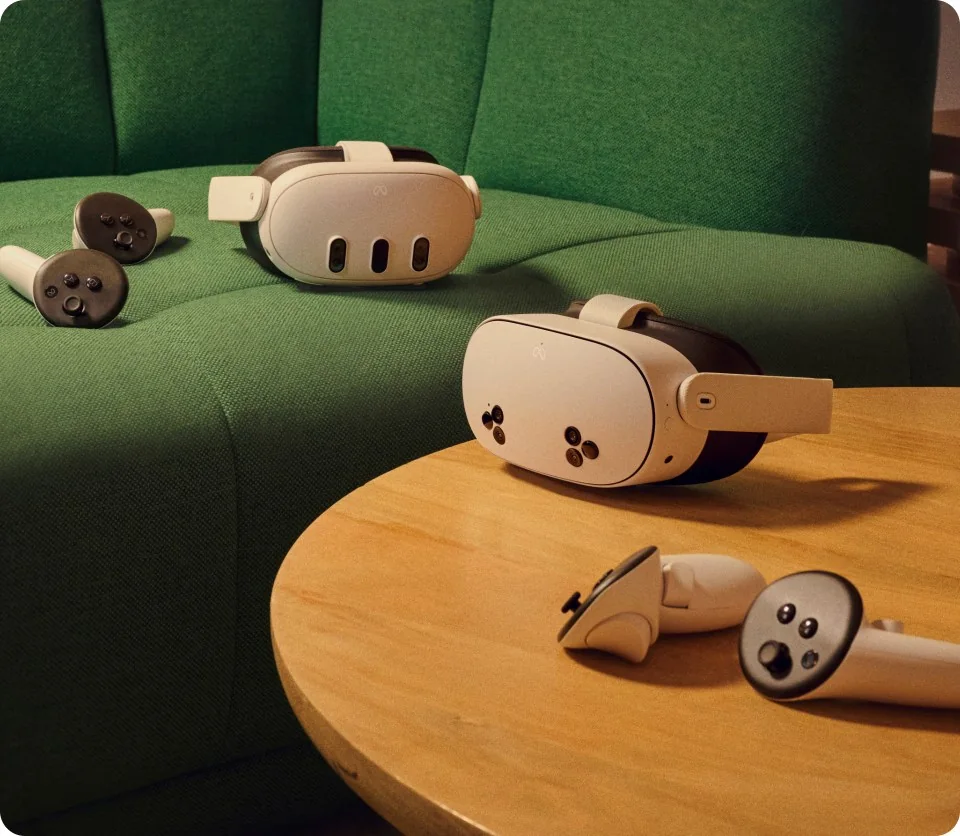
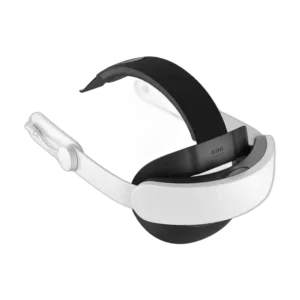
These make sense: an adjustable strap instead of the stock fabric one (the headset stops slipping off a small head), a silicone face pad (easy to wash), case for storage. For Meta goggles, we have straps BOBOVR from KIWI Design, as well as cases and pouches. There’s no point in getting these right away: treadmills, haptic vests, expensive headphones. You can buy them later if VR stays in your home for the long haul.
Birthday gift: what to keep in mind
Buy the headset a few days in advance, set up a parent account, install 3–4 apps, and update the system. The initial setup with updates and configuration takes 30–40 minutes and isn’t a good gift on its own. Set the play area boundaries and a time limit before your child puts on the headset for the first time.
FAQ
At what age can children start using VR goggles?
Meta recommends parent-managed accounts for children aged 10 and up, and full accounts starting at age 13. Other manufacturers typically specify ages 12–13. In schools, VR is used starting in 4th grade in short sessions.
Are VR headsets harmful to children?
With sessions lasting 15–20 minutes, including breaks, in a safe environment, and with age-appropriate content, there is no evidence of harm. Real issues include eye strain, motion sickness, and a headset that’s too loose; all of these can be minimized by following the guidelines in this text.
Can a child who wears glasses use VR?
Yes. The Quest 3 and 3S have space for glasses and allow for lens distance adjustment. An alternative is clip-on prescription lenses.
Which VR headset is best for a 10-year-old?
Meta Quest 3S has parental controls and access to apps for children. Meta Quest 3 is worth considering if image sharpness matters to you and adults will also use the headset. In both cases, check how well the headset fits your child.
How much time per day can a child spend in VR?
A reasonable limit is 2–3 sessions of 15–20 minutes each, with breaks in between. More time doesn’t make the experience any better: it just increases fatigue.
Does VR require a computer?
Standalone headsets (Quest 3, 3S, PICO 4 Ultra) do not. All you need is Wi-Fi to download apps.
Do you have a question about a specific model or about VR for a child with a vision impairment? Contact us, and we’ll advise you before you buy.

Author
Dariusz Walczak
Dariusz Walczak is responsible for marketing at Zenith XR. He manages the brand's communications and blog content.
Potrzebujesz konkretu?
Choose the right XR equipment for your needs
Tell us how you plan to use XR headsets. We will help you choose the right equipment for home, school or business.
Related articles
 Guides
VR headsets and Laboratories of the Future: what the programme actually says, what it does not say and how schools can use it today
6 min czytania Guides
PICO 4 Ultra Enterprise or Meta Quest 3 for business: which should you choose for training, fleet management and presentations?
5 min czytania Guides
Dodaj komentarz