


No products in the cart.
AR glasses instead of a monitor: XREAL One Pro, XREAL One, 1S, Viture Luma, RayNeo Air 3S and ASUS ROG XREAL R1: comparison and buying guide
AR glasses instead of a monitor: XREAL One Pro, XREAL One, 1S, VITURE Luma, RayNeo Air 3S and ASUS ROG XREAL R1: comparison and buying guide

You put on AR display glasses like sunglasses, connect them to a laptop, phone, Steam Deck or console with a single USB-C cable, and see a 150–170-inch screen in front of you. People nearby cannot see what you are doing. They weigh 76–91 g and fit in a case the size of a pencil case. Below, we compare models from our shop by image quality, comfort and connectivity. At the end, we explain which models suit work, gaming, films and users who need vision correction.
How it works and what to expect
Ekran wirtualny. The frames house two micro-OLED panels: one for each eye: with resolutions of 1920×1080 or 1920×1200 pixels. The image looks like a screen suspended a few meters in front of you. Manufacturers list screen sizes ranging from 147 to 174 inches, but these measurements are based on a viewing distance of 4 meters. In practice, what matters is the field of view: that is, how many degrees the screen covers: from 46° (RayNeo) to 57° (XREAL One Pro, ROG R1). The more degrees, the larger the screen appears without having to turn your head.
Connection. One USB-C cable. Requirement: the device must output video via USB-C in DisplayPort mode (also known as DP Alt Mode). This feature is available on MacBooks, laptops with Thunderbolt or USB-C ports marked with a monitor icon, flagship Android phones, iPhones starting with version 15, the Steam Deck, and the ROG Ally. The PS5, Xbox, and Nintendo Switch do not support this: they transmit video via HDMI, so you’ll need an HDMI-to-USB-C adapter or a dock. The ASUS ROG XREAL R1 comes with such a dock: two HDMI 2.0 inputs and one DisplayPort 1.4 input.
Power. The glasses don’t have a battery. Power and video are transmitted via the same cable from your laptop or phone.
Tryby pracy. The simplest option: screen mirroring. On a computer: a second, extended desktop. The XREAL One series (One, One Pro, 1S) features its own X1 processor, which anchors the screen to a specific point in space (3DoF: the image stays in place as you turn your head) and enables 21:9 or 32:9 ultrawide mode if the computer sends such a signal. Viture and RayNeo also stabilize the image in 3DoF; displaying multiple windows at once requires the manufacturer’s app on your computer.
No phone required: XREAL Beam Pro. To kieszonkowe urządzenie z Androidem i sklepem Google Play, które steruje okularami XREAL. Uruchamiasz na nim Netflixa, YouTube’a czy przeglądarkę i wieszasz je w przestrzeni jako osobne okna. Ma baterię 4300 mAh, więc nie zużywa baterii telefonu. Szczegóły urządzenia znajdziesz na karcie XREAL Beam Pro.
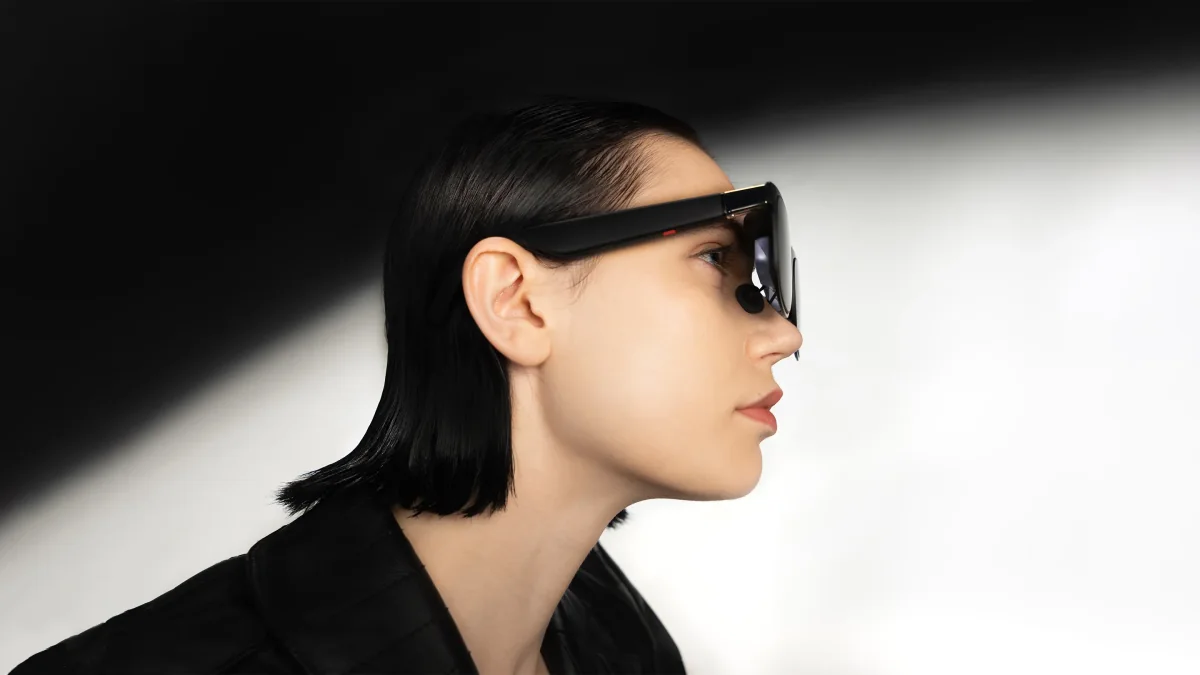
Korekcja wzroku. Three options. First: a frame for prescription lenses that clips onto the eyeglass frames: the optician inserts lenses with your prescription into it. Second: a diopter adjustment dial built into the glasses themselves (Viture Luma and Luma Pro): this works only for nearsightedness. Third: contact lenses. You cannot wear your own glasses underneath any of these models.
Comparison by the Numbers
| Model | Display | Resolution / Refresh Rate | Field of view | Weight | Korekcja wzroku | What it’s for |
|---|---|---|---|---|---|---|
| Xreal One Pro | Sony micro-OLED, flat optics, 700 nits | 1920×1080 / 120 Hz | 57° | 87 g | eyeglass frame included | work, ultrawide, general-purpose |
| Xreal One | Sony micro-OLED, 600 nit | 1920×1080 / 120 Hz | 50° | 84 g | lens mount (optional) | work and films |
| Xreal 1S | Sony micro-OLED, 700 nit | 1920×1200 / 120 Hz | 52° | 82 g | lens mount (adapter) | working with documents (16:10) |
| Viture Luma Pro | Sony micro-OLED, 1000 nit | 1920×1200 / 120 Hz | 52° | 79 g | dial for up to −4.0 D | working with vision impairment |
| Viture Luma | micro-OLED, 1000 nit, soczewki przyciemniane | 1920×1200 / 120 Hz | 50° | 77 g | dial for up to −6.0 D | watching movies with vision impairment |
| RayNeo Air 3S | micro-OLED, 650 nit | 1920×1080 / 60 or 120 Hz | 46° | 76 g | eyeglass frame included | movies on the go |
| RayNeo Air 3S Pro | micro-OLED, 1200 nit | 1920×1080 / 60 or 120 Hz | 46° | 76 g | lens mount (adapter) | pierwszy zakup, jasne miejsca |
| ASUS ROG Xreal R1 | Sony micro-OLED, 700 nit | 1920×1080 / 240 Hz | 57° | 91 g* | lens holder included* | PC and console games, HDMI dock |
| Viture Beast | Sony micro-OLED, 1250 nit, soczewki przyciemniane | 1920×1200 / 120 Hz | No data on the card | 88 g | No built-in memory; check the inserts | konsole, Steam Deck, ROG Ally |
Specifications from our shop’s product pages, as of 1 September 2026. *ROG R1 weight and prescription insert frame details come from the manufacturer’s website, as they are not listed on the product page.
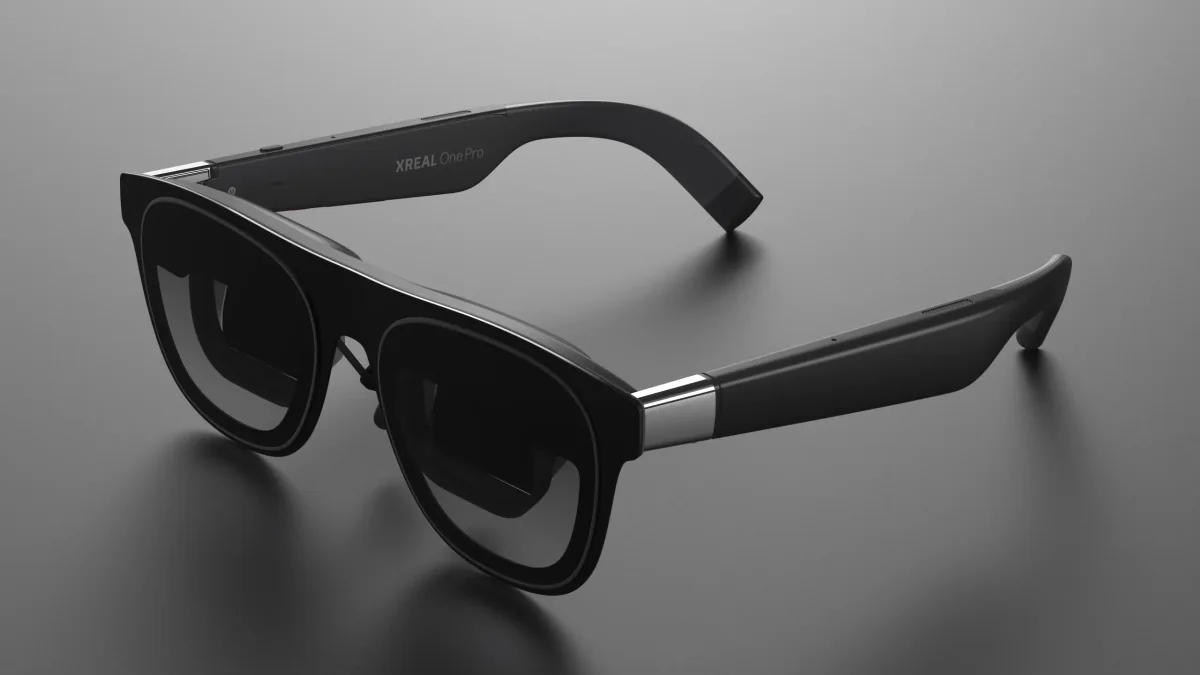
For working on a laptop
Three factors determine whether you can work on it for several hours.
- Text sharpness at the edges. The XREAL One Pro features flat, glare-free optics and the widest field of view (57°), so a spreadsheet remains legible all the way to the edge. In models with a 46–50° field of view, the screen is smaller, but the entire image fits within the sharp central area.
- Proporcje 16:10. The XREAL 1S, Viture Luma, and Luma Pro have a resolution of 1920×1200: 120 more lines than Full HD. You can really tell the difference when working with documents and code.
- Stabilny ekran. The XREAL One series keeps the image in place without any software. The 32:9 ultrawide mode displays two windows side by side, provided the computer supports this resolution.
For work, we choose Xreal One Pro. Xreal 1S offers a 16:10 aspect ratio and 700 nits of brightness, with a narrower field of view. If you need vision correction, check the dioptre adjustment on Viture Luma Pro.
Let’s be honest: this is a single Full HD screen. It replaces the monitor in a hotel or on a train, not the 27-inch 4K monitor on your desk. Increase the system font size by one level.
For gaming and consoles / Steam Deck
Steam Deck and ROG Ally You can connect them directly; every model in the table works. They all have 120 Hz, so there’s no motion blur. For handhelds, we recommend Xreal One: the image stays in place when you rest the console on your lap.
PS5 and Xbox transmit the image via HDMI. This is where ASUS ROG Xreal R1: the included dock has two HDMI 2.0 ports and DisplayPort 1.4, with 240 Hz, a 0.01 ms response time and Bose sound. You can connect a console and PC at the same time and switch without swapping cables.
Without the dock, a bright picture: Viture Beast offers 1250 nits and 9-step lens dimming, right down to a cinema-like blackout.
Brightness and included accessories: RayNeo Air 3S Pro: 120 Hz, 1200 nits, four speakers and a light-blocking cover in the box.
For watching movies on the go
On a plane, what matters is weight, dimming, and whether your iPhone connects without an adapter.
- Lightest: RayNeo Air 3S and 3S Pro (76 g), Viture Luma (77 g), Luma Pro (79 g).
- Przyciemnienie: The Viture Luma and Beast have electrically tinted lenses. The XREAL One and One Pro offer three levels of transparency. The RayNeo Air 3S Pro has a snap-on cover.
- Audio: All models feature directional speakers, but you’ll still want to wear headphones in a quiet train car.
- 3D Movies: The XREAL 1S has a Real 3D feature that converts a regular movie into a 3D movie in real time.
For movies, we recommend RayNeo Air 3S or Viture Luma with 1000 nits of brightness and a dioptre adjustment dial. If you also want to use the same glasses for work, choose XREAL One Pro.
For people with vision impairments
- Nearsightedness up to −4.0 D: Viture Luma Pro, for −6,0 D: Viture Luma. Turn the dial and get a sharp image without needing an optician. Note: It does not correct astigmatism or farsightedness.
- Astigmatism, plus prescriptions, and higher minus prescriptions: lens frame. Take it to an optician along with your prescription. It’s included with the XREAL One Pro, RayNeo Air 3S, and ROG R1; for the XREAL One, 1S, and RayNeo 3S Pro, you’ll need to purchase an adapter separately.
- Interpupillary distance (IPD). The glasses are rigid, so they must fit your interpupillary distance. The XREAL One Pro and ROG R1 come in two sizes, ranging from 57 to 75 mm; the Viture Luma Pro comes in 64 ± 6 and 68 ± 6 mm versions. Measure your IPD at an optician’s or using a smartphone app and provide the measurement when ordering: we’ll select the right variant for you.
- Soczewki kontaktowe address this issue in every model.
Things to watch out for
- Brightness. 600–700 nits (XREAL One, One Pro, 1S, R1) is sufficient in a room or on a train. Near a window in sunlight, 1000 nits (Viture Luma, Luma Pro) and 1200–1250 nits (RayNeo Air 3S Pro, Beast) perform better, as do photochromic lenses.
- Heat buildup and the host’s battery. After an hour, the frames around the temples feel warm: this is normal; if you feel discomfort, lower the brightness. The phone powers the glasses using its own battery, so bring a power bank for a long flight. Viture recommends taking a break after 3–4 hours.
- MacBook and iPhone. A MacBook recognises the glasses as a standard external monitor. You can connect an iPhone 15 or later (USB-C) using the cable included in the box; older iPhones with a Lightning connector do not work directly.
- Cable. Detachable, 1.2 m. A replacement cable must support video output (DisplayPort); not every charging cable can do this.
- Komfort nosa. All the weight rests on your nose and ears. Each model comes with interchangeable nose pads; spending 15 minutes getting the fit right at the start saves hours of discomfort later. The 91 g R1 feels heavier than the 76 g RayNeo.
- Port with no video output. Many cheaper laptops have USB-C ports that are only for charging and data transfer. Check the specs for “DisplayPort Alt Mode” or look for the monitor icon next to the port.
Verdict: Which model for what
- Working on a laptop: XREAL One Pro. If a 16:10 aspect ratio matters to you: XREAL 1S.
- Gaming on PC, PS5, Xbox: ASUS ROG XREAL R1. For Steam Deck: XREAL One or Viture Beast.
- Movies on the go and first purchase: RayNeo Air 3S Pro.
- Vision correction without a visit to the optician: Viture Luma (up to −6.0 D) or Luma Pro (up to −4.0 D).
- A screen without a phone or laptop: dowolne XREAL plus Beam Pro.
You can find all models in the category AR glasses with a display; we cover industrial glasses for maintenance and manufacturing in a separate guide.
FAQ
What are AR glasses?
Glasses with small displays built into the lenses, through which you can still see your surroundings. The models in this comparison display images from a connected device: they function like a portable monitor. Industrial AR glasses (RealWear, Vuzix) have their own system and camera for use in maintenance and manufacturing; this is a different category.
Which are better: AI glasses or AR glasses?
These are two different tools. AI glasses (e.g., Ray-Ban Meta) have a camera, speakers, and a voice assistant, but no screen: you can’t work on them or watch a movie. AR glasses with a display show the full image from a laptop or phone. For work and movies, choose AR; for photos, calls, and voice prompts: AI glasses.
What are the best AR glasses for working with a laptop?
In our shop, XREAL One Pro offers a 57° field of view, flat optics, 120 Hz and a prescription insert frame in the box. If a 16:10 screen matters to you, consider XREAL 1S.
Will AR glasses replace a monitor for everyday use?
When traveling, yes: it’s a full-fledged Full HD laptop screen. On your desk, they won’t replace a large 4K monitor, since they offer a single screen with a resolution of 1920×1080 or 1920×1200.
Can I connect them to a PS5 or Xbox?
Yes, but the consoles have HDMI ports, and the glasses have USB-C ports. You’ll need an HDMI-to-USB-C adapter with power or a model that comes with a dock: the ASUS ROG XREAL R1.
Can I use them if I have a vision impairment?
Yes. For nearsightedness up to −4.0 D (Luma Pro) or −6.0 D (Luma), you can adjust the focus using the dial. For other vision impairments, an optician will insert lenses into a prescription frame: the XREAL, RayNeo, and ROG R1 all support this.
Not sure which model is right for your laptop, phone, or console? Napisz : We’ll check port compatibility before you buy, select the right size based on your interpupillary distance, and issue a VAT invoice.

Author
Dariusz Walczak
Dariusz Walczak is responsible for marketing at Zenith XR. He manages the brand's communications and blog content.
Potrzebujesz konkretu?
Choose the right XR equipment for your needs
Tell us how you plan to use XR headsets. We will help you choose the right equipment for home, school or business.
Related articles
 Guides
VR headsets and Laboratories of the Future: what the programme actually says, what it does not say and how schools can use it today
6 min czytania Guides
PICO 4 Ultra Enterprise or Meta Quest 3 for business: which should you choose for training, fleet management and presentations?
5 min czytania Guides
Dodaj komentarz