


No products in the cart.
VR trackers and full-body tracking: VIVE Tracker 3.0, Ultimate Tracker, PICO Motion and Tundra: which should you choose for games, motion capture and research?
VR trackers and full-body tracking: VIVE Tracker 3.0, Ultimate Tracker, PICO Motion and Tundra: which should you choose for gaming, mocap and research?
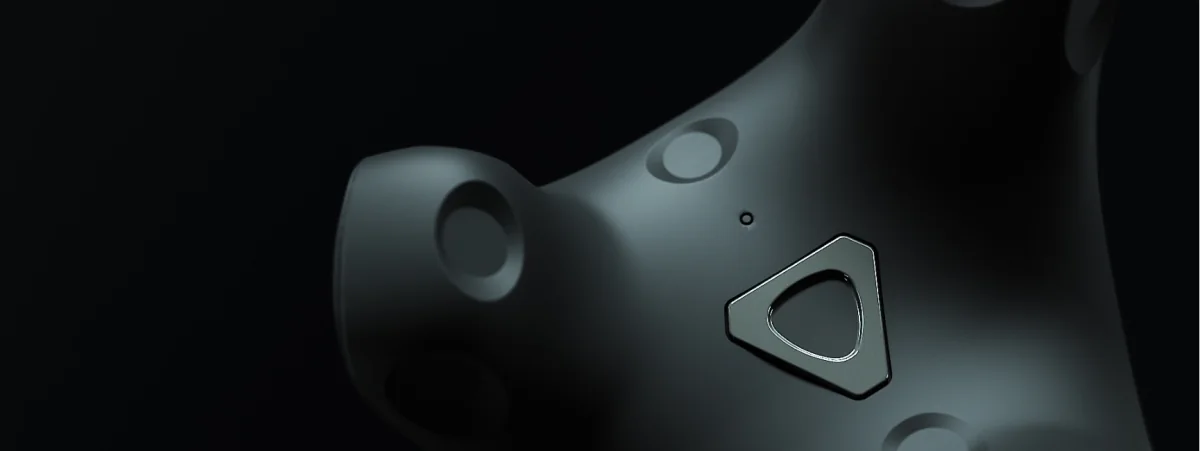
VR headsets track your head and hands. The rest of your body in the game stands stiff as a board, and in motion capture or gait analysis, it simply isn’t there. A VR tracker is a small sensor that you clip to your waist, foot, elbow, or a prop, thereby adding another tracking point. Three of them provide full-body tracking: the avatar walks, crouches, and dances just like you do. Below, we compare five devices from our lineup and recommend which ones to buy for VRChat, animation, and the lab.
Two tracking systems
Trackers fall into two categories, and this is the first decision you need to make: one that’s more important than the brand.
Ze stacjami bazowymi (SteamVR Lighthouse). You hang them in the corners of the room stacje bazowe 2.0, which scan the room with a laser 100 times per second. The tracker has optical sensors on its housing and uses the laser pulses to calculate its position with sub-millimeter accuracy. This is how VIVE Tracker 3.0 and Tundra Tracker. Requirements: at least two tracking stations, a computer with SteamVR, and a headset that also uses the tracking stations (VIVE Pro, VIVE Cosmos Elite, Valve Index). This is the most accurate and stable system, but it requires installation.
Without tracking stations (inside-out). The sensor determines its own position. VIVE Ultimate Tracker It has two wide-angle cameras and maps the room just like standalone headsets. PICO Motion Trackers It has a gyroscope, an accelerometer, and 12 infrared sensors, and the PICO headset’s algorithm fills in the missing parts of the silhouette. No setup required, calibration takes just a few seconds, and you can take the set to another room. The price you pay for convenience: lower precision than with Lighthouse, and performance depends on the lighting in the room.
There’s also a third option that we don’t offer: SlimeVR. This is an open-source tracker project based solely on inertial measurement units (IMUs), connected over Wi‑Fi. They do not need base stations or cameras and work with SteamVR and standalone Quest in VRChat via OSC. The drawback is orientation drift, which needs resetting periodically by double-tapping the chest tracker. This is an alternative for players who want to use IMU trackers; it is not suitable for measurement work.
Comparison of trackers from the Zenith XR lineup
| Model | System | Requires | Headsets | Use |
|---|---|---|---|---|
| VIVE Tracker 3.0 | Lighthouse | Station 1.0 or 2.0 + computer | SteamVR, VIVE Pro, VIVE Cosmos | gry, mocap, badania, rekwizyty |
| Tundra Tracker | Lighthouse | Station 1.0 or 2.0 + computer | SteamVR (stacje bazowe) | games, motion capture; lightest (46–50 g) |
| VIVE Ultimate Tracker 3+1 Kit | inside-out, kamery | nothing else needed with VIVE headsets; computer required for SteamVR | VIVE Focus Vision, Focus 3, XR Elite; SteamVR via VIVE Hub | games, fitness, dance, motion capture in open spaces |
| PICO Motion Trackers | inside-out, IMU + infrared | PICO headsets only | PICO 4, PICO 4 Ultra, 4 Ultra Enterprise | gry, taniec, fitness |
| HTC Base Station 2.0 | Lighthouse (nadajnik) | zasilania; min. 2 szt. | SteamVR, Valve Index, VIVE Pro, VIVE Cosmos Elite | area 5×5 m (2 units) up to 10×10 m (4 units) |
Weight and battery life: Tracker 3.0, 75 g and up to 7.5 h; Tundra, 46–50 g and 7–9 h; Ultimate, 94 g and up to 7 h; PICO, 27 g and over 25 h. All charge via USB‑C.
What does this mean in practice? Do you have a headset with base stations, such as VIVE Pro or Index? Choose Tracker 3.0 or Tundra, since you already have the stations. Do you have VIVE Focus Vision, Focus 3 or XR Elite? Ultimate Tracker works with them without a computer. Do you have PICO 4 Ultra? PICO Motion works with this headset without base stations. Do you have Meta Quest 3? Quest does not support any of these trackers on its own; you need a computer with SteamVR, where Ultimate Tracker is the simplest option (HTC has supported other headset brands through VIVE Hub since October 2024).
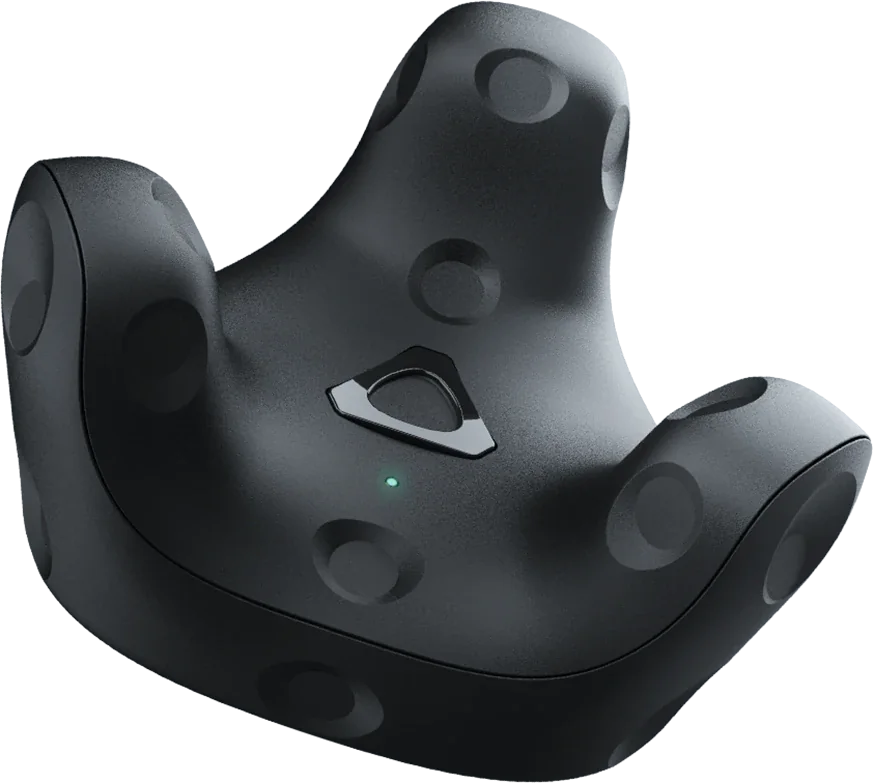
Full-body tracking kit for games
VRChat, dance apps, and fitness apps require a minimum of three tracking points: hips and both feet. VRChat supports up to eight additional trackers: feet, knees, hips, torso, and elbows. Five or six trackers make sense if you’re dancing or recording; for a regular conversation in VRChat, three are enough.
Option A: You have a computer and SteamVR headset with base stations
- 3× VIVE Tracker 3.0. Each includes its own USB receiver, so you will use three ports. You can add a USB hub or choose Tundra, where one SW3 receiver supports three trackers.
- Hip and foot straps: these aren’t included in the set; you’ll need to purchase them separately.
- If you do not have base stations, include 2× Base Station 2.0.
- Pair the trackers in SteamVR; in VRChat, click “Calibrate FBT” in front of a mirror.
Option B: VIVE standalone headset, no computer
- VIVE Ultimate Tracker 3+1 Kit. W pudełku trzy trackery, mocowania 1/4″, kable i odbiornik do gogli.
- Headsets: VIVE Focus Vision. This setup does not require base stations to be installed in the room.
Option C: PICO
- PICO Motion Trackers: a pair of ankle trackers. PICO’s algorithm uses them to reconstruct 24 skeletal points.
- Headsets: PICO 4 Ultra. PICO Connect also passes tracker data to SteamVR when you connect the headset to a computer.
Option D: Meta Quest 3 or 3S
The Quest does not support trackers on its own. For Quest 3 you add a computer, SteamVR, VIVE Hub and Ultimate Tracker 3+1 Kit. The only computer-free alternative is IMU trackers such as SlimeVR via OSC in VRChat.
For motion capture and animation
Animators use trackers for motion capture: a tracker appears in SteamVR like any other device, so Unity and Unreal can read its position through the SteamVR plugin or OpenXR. The choice here is straightforward: Lighthouse. Base stations provide sub-millimetre positional accuracy and do not “drift” when lighting changes. VIVE Tracker 3.0 and Tundra have a standard 1/4-inch thread, so you can also attach them to a prop, camera or tripod. Tundra also has an I/O board with a touchpad, trigger and haptic feedback, which can be used to build custom controllers and simulator accessories.
How many units? For the body alone, 5–6 (hips, feet, elbows, or knees); for the body with a prop, 7. With seven VIVE trackers, you’ll use up seven USB ports; Tundra solves this with a single SW7 receiver. Coverage area: two 2.0 stations cover 5×5 m; four stations cover up to 10×10 m. If you’re recording outside the studio, on location, the Ultimate Tracker makes more sense because it doesn’t require stations.
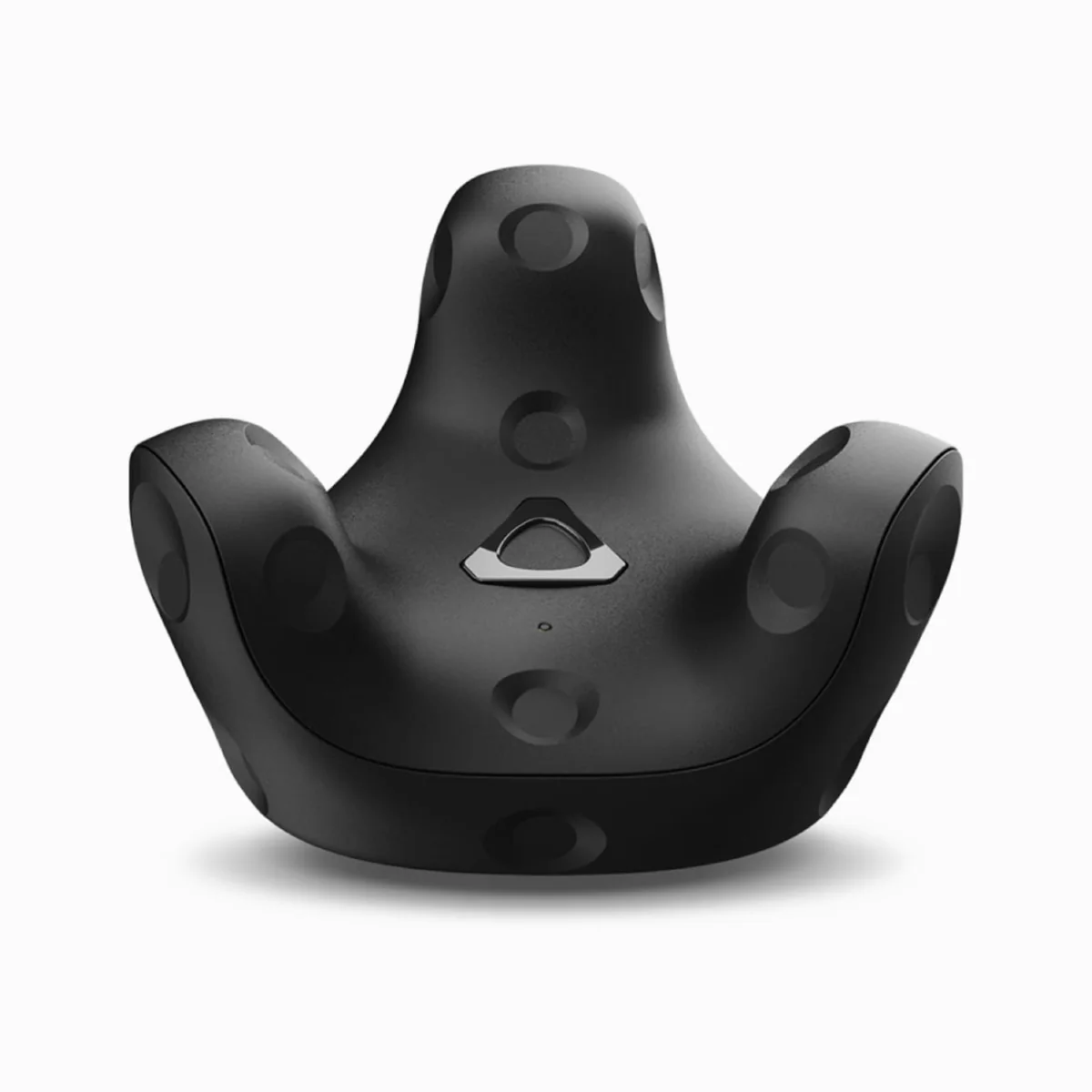
For motion research at a university
Biomechanics, rehabilitation, and UX labs ask for two things: accuracy and repeatability. The honest answer:
- Lighthouse (Tracker 3.0, Tundra) provides sub-millimetre tracking according to the system manufacturers; it is used in VR setups for gait analysis, reach measurement and prop positioning in experiments. It requires fixed base stations and covered mirrors and windows.
- Ultimate Tracker has been independently measured: a study from September 2024 (arXiv 2409.01947) reports an average precision of 4.98 mm ± 4 mm, with the greatest influence coming from lighting, movement speed, and distance from the calibration point. The authors considered this accuracy sufficient for many motion-tracking applications, including those outside of VR. It is a good choice for studies where the mobility of the setup is important; however, it is not suitable for submillimeter measurements.
- PICO Motion The manufacturer describes it as having an average deviation of 5 cm and an angular error of 6°. This is a tool for behavioral and interaction research, not for biomechanics.
If the study focuses on vision rather than the body, that’s a different matter: the Pupil Labs eye-tracking module for Quest 3 records fixations, blinks and pupil diameter. For university purchases, we can configure a set with spare trackers, base stations and stands and issue an invoice. Tell us what you want to measure.
Most Common Issues
- Station range. Station 2.0 tracks up to 7 m, with a field of view of 160°×115°. Mount them in opposite corners, above head height, angled downward; the tracker must be able to see at least one station. For a larger room, add a third and fourth station.
- Odbicia. Mirrors, windows, TVs, and shiny surfaces reflect the laser and cause the tracker to “jump.” Cover them during the session. Applies only to Lighthouse.
- Dryf. This issue is virtually nonexistent with Lighthouse. The Ultimate Tracker loses precision if you change the lighting or rearrange furniture after mapping the room; in that case, recalibrate. IMU trackers (SlimeVR) drift by design and require a reset every dozen or so minutes.
- Baterie. Lighthouse and Ultimate last 7–9 hours, which is one long session; PICO lasts over 25 hours. Charge all units at once: each has a USB-C port: and the Ultimate takes 2.2–3.2 hours to charge.
- Odbiorniki USB. Tracker 3.0: one receiver per tracker. Tundra: one for every 3, 5, or 7. Ultimate: one for up to 5. Unplug the receiver from the back of the computer case using an extension cord and place it within the trackers’ line of sight, because the 2.4 GHz signal doesn’t work well through metal casings.
- Straps and mounts. No Lighthouse tracker comes with a strap in the box. Plan for them in your budget right away, because without them, the set will just sit in a drawer.
FAQ
How many trackers do you need for full-body tracking?
Three: hips and both feet. Five or six if you also want elbows or knees (dancing, motion capture). VRChat supports up to eight additional trackers.
Do VR trackers work with the Meta Quest 3?
Not on their own. When connected to a computer running SteamVR, the Quest 3 supports the VIVE Ultimate Tracker via VIVE Hub. Lighthouse trackers will also work on a computer, but they require base stations. Without a computer, the only option is IMU trackers like SlimeVR, which we do not sell.
Does the VIVE Tracker 3.0 work without base stations?
No. Without 1.0 or 2.0 base stations, it won’t determine your position. If you don’t want to set anything up, choose the VIVE Ultimate Tracker or PICO Motion Trackers.
How does the VIVE Tracker 3.0 differ from the VIVE Ultimate Tracker?
Tracker 3.0 uses base stations and provides the highest precision. Ultimate Tracker has its own cameras, does not need base stations and works without a computer with VIVE Focus Vision, Focus 3 and XR Elite headsets.
Does the PICO Motion Tracker work with SteamVR?
Yes, via PICO Connect, when PICO headsets are connected to a computer. It does not work with headsets from other brands.
What should a full body tracking setup include?
Choose the setup to match your headset and tracking system. Include trackers, receivers, straps and mounts. Lighthouse requires base stations and a computer; Ultimate Tracker has its own cameras, while PICO Motion works with supported PICO headsets.
Not sure which system is compatible with your headset or how many base stations your room needs? NapiszWe’ll put together a kit, add the headbands and stands, and issue a VAT invoice. You’ll find all models in the category Trackers and sensors.

Author
Dariusz Walczak
Dariusz Walczak is responsible for marketing at Zenith XR. He manages the brand's communications and blog content.
Potrzebujesz konkretu?
Choose the right XR equipment for your needs
Tell us how you plan to use XR headsets. We will help you choose the right equipment for home, school or business.
Related articles
 Guides
VR headsets and Laboratories of the Future: what the programme actually says, what it does not say and how schools can use it today
6 min czytania Guides
PICO 4 Ultra Enterprise or Meta Quest 3 for business: which should you choose for training, fleet management and presentations?
5 min czytania Guides

Dodaj komentarz